






Some days, your toddler eats more than you expected. On other days, the toast is untouched, the fruit is refused and the meal seems to end after two bites.
A food they happily ate last week might suddenly be unacceptable. The same small group of familiar foods can appear on repeat, leaving you wondering whether their diet is varied enough—or whether you need to do something more.
These concerns are understandable. But fussy eating does not have one cause, one level of concern or one solution.
This guide explores the different ways parents can support a fussy toddler’s nutrition, including food-first strategies, nutrient-rich familiar foods, homemade smoothies, fortified products, supplements, age-specific toddler nutrition smoothies and professional support.
About this guide: This article was prepared by Optivance Nutrition to help parents understand the different ways they may support a fussy toddler’s nutrition. Optivance develops an age-specific Toddler Smoothie, which is discussed transparently as one option within a broader range of food-first, supplementary and professional-support approaches.
What can parents do when a toddler eats a limited range of foods?
There is no single approach that suits every toddler. Depending on your child’s overall diet, development and individual needs, possible next steps include:
- Continuing to offer balanced meals and snacks at predictable times
- Building from familiar foods rather than removing them
- Adding nutrient-rich ingredients where appropriate
- Maintaining calm, repeated exposure to different foods
- Using fortified foods thoughtfully
- Preparing homemade smoothies from accepted ingredients
- Discussing targeted supplements where needed
- Considering an age-specific toddler nutrition product
- Seeking individual advice when eating, growth or feeding causes concern
The right starting point depends on your child—not simply on how much they ate at one meal.
Is fussy eating normal in toddlers?
Fussy eating is common during the toddler years.
Young children may object to the taste, shape, colour or texture of certain foods. They might enjoy something one day and refuse it the next, resist unfamiliar foods or eat considerably more or less from one day to another. Changing activity levels, growth and a developing sense of independence can all influence this behaviour.
Toddlers also have small stomachs and may need much smaller portions than adults expect. Rather than judging their diet by one meal or one difficult day, it can be more helpful to consider what they eat across a week or longer.
This does not mean every form of restricted eating should be dismissed as a phase.
There is a meaningful difference between a toddler who occasionally refuses dinner but eats from several food groups across the week and a child whose list of accepted foods is very small, continues to shrink or excludes entire food groups.
Feeding Your Fussy Eater Without the Fight
The Toddler Taster and Texture Explorer: Helping Fussy Eaters Try New Foods
Toddler Food Choices: How Structured Options Can Make Mealtimes Easier
Does fussy eating mean your toddler is missing nutrients?
Not automatically.
Food refusal alone cannot tell you whether a toddler has a nutrient deficiency. Their overall diet, growth, energy, health and feeding ability all need to be considered.
Research has linked picky eating with lower dietary variety and lower intake of some foods, particularly fruit and vegetables. But research definitions vary, and being a fussy eater does not establish that an individual child has poor growth or a diagnosed deficiency.
Parents sometimes use the phrase nutrition gap to describe the difference between the foods they hope their toddler will eat and what is actually accepted. That can express a genuine concern, but it should not be treated as evidence of a clinical deficiency.
A more useful starting point is to look at patterns over time:
- Does your toddler eat something from most food groups across the week?
- Are entire food groups consistently absent?
- Is their accepted-food list stable, gradually expanding or continuing to shrink?
- Are drinks frequently replacing food?
- Can they chew and swallow age-appropriate textures comfortably?
- Do they have their usual energy to play, learn and explore?
- Are you or a health professional concerned about their growth?
Fussy eating exists on a continuum. A child who occasionally rejects familiar foods but maintains variety and growth is different from a child whose intake is inadequate, mealtimes are consistently distressing or whole food groups are excluded.
Australian guidance recommends speaking with a GP, child and family health nurse or dietitian if your toddler eats only a very small range, consistently refuses food, avoids entire food groups for several weeks or causes concern about growth or overall nutrition.
Vitamins and minerals for toddlers → Understanding Vitamins & Nutrition for Toddlers
How much should a toddler eat in a day?
Start with food-first foundations
Normal food should remain the foundation of toddler nutrition.
Australian dietary guidance recommends offering foods from five main groups: vegetables and legumes, fruit, grain foods, protein-rich foods, and milk, yoghurt, cheese or suitable alternatives. The recommended number of serves varies by age, activity and growth, and the pattern does not need to look perfect at every meal.
Meals and snacks also provide more than nutrients. They give toddlers opportunities to practise chewing, experience different textures, take part in family routines and gradually become familiar with a wider range of foods.
Keep meals and snacks predictable
Regular eating opportunities can make family routines easier to understand.
Offer meals and nutritious snacks at broadly predictable times rather than allowing continuous grazing throughout the day. This gives your toddler repeated opportunities to eat without expecting them to consume the same amount each time.
Predictability does not mean rigidity. A toddler might eat very little at lunch and be much hungrier at the next planned snack.
Begin with small portions
A full adult-style plate can feel overwhelming to a child with a small appetite.
Begin with a modest amount and offer more when your toddler shows they are still hungry. This reduces pressure while allowing them to respond to their own appetite.
Include a familiar food
A familiar food gives your toddler something they recognise while allowing another food to be present without pressure.
This might look like:
- Familiar toast with a small amount of egg
- Accepted pasta beside a spoonful of a different sauce
- Yoghurt with fruit offered separately
- Crackers alongside a new dip
- A preferred vegetable beside a less familiar one
The familiar food is not a reward for eating something else. It is simply part of creating a meal that feels manageable.
Keep offering foods without demanding that they are eaten
Toddlers may need to encounter a food many times before it becomes familiar.
Exposure can include seeing, smelling, touching, licking or tasting—not only finishing a portion. A systematic review found moderate evidence that repeated tasting of vegetables or fruit over eight to ten or more days can increase acceptance among infants and toddlers, although individual responses vary.
Avoid presenting a fixed number of attempts as a guarantee. Some foods may be accepted quickly, while others may take much longer.
Reduce pressure around eating
A helpful division of responsibility is:
The parent provides the food and structure. The toddler decides whether and how much to eat.
Trying to force a toddler to finish their plate can increase stress around meals. Bribing them with dessert can also make the preferred reward appear more desirable than the food being negotiated over.
Maintaining structure does not mean preparing an entirely different meal every time food is refused. It means providing regular, appropriate options and allowing the child to respond to their appetite.
Model the behaviour you want to encourage
Eating together gives toddlers a chance to see familiar adults enjoying the same foods.
Family meals do not need to be elaborate or perfectly calm. Even short, ordinary opportunities to sit together can help food feel like a normal shared experience rather than a test the child must pass.
Practical strategies for fussy toddler mealtimes → Fussy-eater tips
Low-pressure feeding strategies → Feeding Your Fussy Eater Without the Fight
Toddler food textures and small-step exposure → The Toddler Taster and Texture Explorer
Make accepted foods work harder
Supporting nutrition does not always require creating an entirely new meal.
Sometimes a familiar food can become the foundation for adding variety or increasing its nutritional contribution.
Depending on your toddler’s preferences and dietary suitability, you might:
- Add yoghurt to an accepted fruit
- Pair toast with egg, cheese, avocado or a suitable spread
- Mix beans or lentils through a familiar sauce
- Add milk or yoghurt to porridge
- Pair crackers with hummus, cheese or another accepted dip
- Serve familiar ingredients as a deconstructed meal
- Add nut or seed paste where safely introduced, age-appropriate and allergy-safe
- Offer a preferred food in a slightly different texture or shape
- Combine a familiar carbohydrate with an accepted protein food
The aim does not need to be hiding every unfamiliar ingredient.
Blending ingredients into familiar foods can be practical, but toddlers also benefit from seeing, touching and learning about recognisable foods and textures. A useful principle is:
Build from what your toddler already accepts while continuing to create small, pressure-free opportunities to explore other foods.
How to make toddler meals more nutrient-dense
High-protein foods for fussy toddlers
Iron-rich foods for fussy toddlers
Healthy snacks for toddlers with small appetites
Nutritional options parents may consider
Food-first strategies remain central, but parents may also encounter a range of products and approaches designed to support children’s nutrition.
These options do not all perform the same role.
1. Normal meals and snacks
Meals and snacks provide opportunities for:
- Dietary variety
- Chewing and oral development
- Exposure to different textures
- Shared family routines
- Learning to respond to hunger and fullness
- The gradual development of food preferences
Their limitation is not that normal food is nutritionally inadequate. It is that the value of a meal depends partly on what the toddler actually eats—and that can be unpredictable.
Normal meals and snacks should remain part of the child’s routine even when a supplementary product is used.
2. Nutrient-enriched familiar foods
This approach adds suitable ingredients to foods your toddler already accepts.
Examples include enriching porridge with yoghurt, adding avocado to a familiar spread, serving fruit with yoghurt or mixing legumes through an accepted sauce.
Its main advantages are flexibility and familiarity. It remains food-based and can often be adapted to the meals the family already prepares.
Its limitations are that it depends on what the child accepts and does not automatically address every nutrient a parent may be concerned about.
For a child with a very restricted range or known allergies, individual guidance may help identify appropriate additions without unnecessarily removing other foods.
3. Homemade smoothies
A homemade smoothie can combine accepted ingredients such as:
- Milk or a suitable alternative
- Yoghurt
- Fruit
- Oats
- Avocado
- Nut or seed pastes where suitable
- Other familiar foods
Homemade smoothies are flexible and allow parents to adjust flavour, thickness and ingredients.
Their nutritional profile, however, depends entirely on the recipe. A fruit-and-yoghurt smoothie cannot automatically be assumed to contain consistent amounts of iron, iodine, DHA, probiotics or other selected nutrients.
That does not make homemade smoothies a poor choice. It simply means they have a different role from a product with a standardised formulation.
Smoothies can also be filling. Consider when they are offered so that they do not repeatedly replace meals or opportunities to chew and explore normal food textures.
Creative homemade and Optivance smoothie ideas → Creative Smoothie Recipes for Toddlers
4. Fortified foods and drinks
Fortified products have selected nutrients added to them.
Examples can include:
- Iron-fortified cereals
- Fortified milk or dairy alternatives
- Packaged foods containing added vitamins or minerals
- Fortified drinks developed for particular age groups
Fortification can provide a convenient source of selected nutrients, but the front of the pack rarely tells the whole story.
Parents should check:
- The intended age
- Serving size
- Which nutrients are included
- The amount provided per serve
- Total and added sugar
- Ingredients and allergens
- How the product is intended to fit into the diet
- Whether the product duplicates another supplement or fortified food
The Royal Children’s Hospital notes that some packaged toddler foods provide useful added nutrients, while others may contain high levels of sugar or ingredients the child does not need. Reading the full nutrition and ingredient information is therefore more helpful than relying on general front-of-pack language.
Packaged foods can make busy routines easier, but toddler-focused packaging does not always show how well a product fits your child’s broader diet. Checking the main ingredients, food-group contribution, sugars, sodium, allergens and texture can help you make a more informed choice. Use eight simple checks to compare packaged foods for toddlers → How to Choose Packaged Foods for Toddlers: 8 Simple Checks.5. Age-specific toddler nutrition smoothies
An age-specific toddler nutrition smoothie is designed to provide a consistent combination of selected nutrients in a measured serve.
Depending on the formulation, it may contain:
- Protein
- Fibre
- Vitamins and minerals
- Omega-3
- Probiotics
- Other food or supplementary ingredients
Potential advantages include convenience, portioning and a consistent nutritional profile.
Its limitations are equally important:
- It cannot replace learning to eat normal foods
- It may not suit every toddler’s taste or texture preferences
- It might contain allergens
- It is not necessary for every child
- It can duplicate nutrients supplied by other products
- It should not routinely displace meals
- It is not the same as prescribed medical nutrition
Parents should check the intended age and regulatory purpose rather than assuming that toddler drinks, adult protein powders, multivitamins and medical nutrition products are interchangeable.
In Australia, formulated supplementary foods for young children are currently regulated under Standard 2.9.3 and are intended to supplement the diets of children aged 1–3 in limited circumstances.
What to look for in a toddler nutrition smoothie → What to Look for in a Toddler Nutrition Smoothie for Fussy Eaters
6. Do fussy toddlers need supplements?
Not necessarily. Fussy eating on its own does not mean a toddler needs a supplement. Many children can meet their nutritional needs through a varied diet even when their appetite and food preferences change from day to day.
The question becomes more relevant when a toddler accepts a very limited range of foods, consistently avoids entire food groups or has other factors that may make it harder to meet nutritional needs.
A multivitamin can provide selected vitamins and minerals, but it is not the same as food or a toddler nutrition smoothie. It generally does not provide meaningful amounts of protein, fibre or food energy.
An age-specific toddler nutrition smoothie has a different role. Depending on the formulation, it may provide protein, fibre and other nutrients alongside vitamins and minerals in a food-style format.
Neither approach should automatically replace normal meals, snacks or continued exposure to different foods. If your toddler eats only a very narrow range, their accepted foods continue to shrink, or you are concerned about growth or nutrient intake, speak with a GP, child and family health nurse or accredited practising dietitian.
Understanding toddler vitamins and supplements → Understanding Vitamins & Nutrition for Toddlers
Does my fussy toddler need a multivitamin?
7. Medical or prescribed nutrition products
Medical nutrition products have a different purpose from normal foods, general supplements and consumer toddler products.
Foods for special medical purposes are intended to manage the diets of people with particular diseases, disorders or medical conditions. They can sometimes be used as the sole source of nutrition or as a supplement and are intended to be used under professional supervision.
A consumer toddler nutrition smoothie should not be presented as a substitute for:
- A prescribed oral nutrition supplement
- A feeding assessment
- An individual dietetic plan
- Medical management of poor growth
- Support for swallowing or oral-motor difficulty
8. Professional feeding and nutrition support
Sometimes the most appropriate next step is not another product. It is individual assessment.
Depending on the concern, support may involve:
- A GP
- Child and family health nurse
- Accredited practising dietitian
- Speech pathologist
- Occupational therapist
- Paediatrician
- Multidisciplinary feeding service
The right professional depends on the underlying concern.
Questions about food groups or nutrient intake may be suited to a dietitian. Coughing, choking or difficulty managing textures might require assessment by professionals with feeding and swallowing expertise. Significant sensory distress or a highly restricted diet may require a broader team.
Fussy eating is common in toddlerhood, but some patterns deserve closer attention. A shrinking food range, distress around meals, difficulty chewing or swallowing, poor growth or reliance on only a few foods may indicate that extra support is needed. Recognise when fussy eating may be more than a typical phase → When Is Fussy Eating More Than a Phase?.
Comparing the available options
| Option | Potential role | Main strength | Important limitation |
|---|---|---|---|
| Meals and snacks | Everyday nutrition and food learning | Supports dietary variety, chewing and family eating | Intake can be unpredictable |
| Nutrient-enriched familiar foods | Adds nutrition to accepted meals | Flexible and food-based | Depends on what the toddler accepts |
| Homemade smoothies | Combines familiar ingredients | Customisable flavour and texture | Nutritional profile varies by recipe |
| Fortified foods | Provides selected added nutrients | Convenient and widely available | Amounts, sugar and purpose vary |
| Vitamin or mineral supplements | Provides selected micronutrients | Simple format | Does not provide protein, fibre or food experience |
| Toddler nutrition smoothies | Provides measured supplementary nutrition | Consistent formulation and preparation | Not needed by every toddler and should not replace food |
| Medical nutrition products | Supports identified clinical needs | Formulated for specific nutrition management | Requires professional supervision |
| Feeding and nutrition support | Assesses the individual child | Addresses the child’s specific needs | Requires access to the right professional |
Considering an age-specific toddler nutrition smoothie?
Learn what to check before choosing one, including age suitability, protein, fibre, sugar, omega-3, probiotics, vitamins, minerals, ingredients and allergens.
Read the Toddler Smoothie Buying Guide
Explore Optivance Toddler Smoothie
Nutrients parents commonly ask about
No single nutrient should be considered in isolation.
A toddler’s overall dietary pattern, growth and individual circumstances matter more than one large number on a product label.
Protein
Protein comes from foods including meat, poultry, fish, eggs, dairy foods, tofu, legumes, nuts, seeds and grain foods.
Parents might focus on protein when a toddler avoids meat or eats only small portions. But a toddler product should not be judged by having the highest possible protein figure. The amount needs to be considered alongside the child’s broader diet and the product’s intended role.
Protein for toddlers—how much do they need?
Iron
Iron is frequently raised in conversations about fussy eating because many familiar toddler snack foods contain relatively little of it.
Food sources include:
- Meat and poultry
- Fish
- Eggs
- Legumes
- Tofu
- Iron-fortified cereals
Food fussiness alone cannot diagnose iron deficiency. Parents concerned about iron intake, symptoms or growth should seek individual advice rather than starting an iron supplement without assessment.
Iron-rich foods for fussy toddlers
Fibre
Fruit, vegetables, legumes and wholegrain foods can all contribute fibre.
Fibre included in a toddler nutrition product may contribute to the child’s overall intake, but it does not replace offering ordinary fibre-containing foods and age-appropriate textures.
Fibre for toddlers—food sources and practical ideas
Calcium and vitamin D
Milk, yoghurt, cheese and suitable alternatives can contribute calcium. Vitamin D intake and status can depend on food intake, sun exposure and individual health factors.
Removing dairy or another major food group without appropriate guidance may affect nutrient intake, particularly where several foods are already excluded. The Royal Children’s Hospital recommends discussing suspected allergies before unnecessarily cutting out foods or food groups.
Zinc and iodine
Zinc and iodine are required in relatively small amounts and occur in different foods. Some fortified products also contain them.
The presence of either nutrient in a formula does not prove that an individual toddler was previously deficient. It tells parents what the product contributes when used as directed.
Omega-3 and DHA
Omega-3 refers to a family of fats rather than one single ingredient.
When assessing a toddler product, parents should check:
- Which type is included
- Its source
- The quantity per serve
- Whether that information is clearly disclosed
The phrase “contains omega-3” provides less useful information than a label specifying the exact type and amount.
Omega-3 food sources and DHA for toddlers → The Essential Guide to Omega-3 for Toddlers
B vitamins
B vitamins are found across a wide range of foods and are also commonly included in fortified products.
More is not automatically better. The relevant question is whether the amount is appropriate for the intended age and how it fits with the child’s total intake from foods and other products.
Probiotics
Products containing probiotics can differ by organism and quantity.
Parents should look for named strains, the amount provided and relevant storage directions rather than assuming every product labelled “probiotic” offers the same formulation or outcome.
How Optivance Toddler Smoothie fits
Some families can navigate a fussy phase through meals, snacks, repeated exposure and changes to food preparation.
Other families may want an age-specific nutritional top-up available for days when appetite is small or accepted foods feel particularly repetitive.
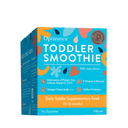
Optivance Toddler Smoothie was developed for the second situation.
It is classified as a Formulated Supplementary Food for Young Children and is intended to supplement a normal diet where an individual child’s intake of energy and nutrients may not be adequate to meet their requirements. It is not a complete meal replacement or a medical nutrition product.
What one serve provides
One 25 g sachet prepared with 180 mL water provides:
| Per serve | Amount |
|---|---|
| Energy | 433 kJ / 103 Cal |
| Protein | 10.6 g |
| Dietary fibre | 1.9 g |
| DHA omega-3 | 40 mg |
| Probiotics | 3 billion CFU |
| Micronutrient profile | 16 vitamins and minerals plus lutein |
| Total sugars | 5.3 g |
The three probiotic strains are:
- Lactobacillus acidophilus
- Bifidobacterium animalis
- Lacticaseibacillus rhamnosus
The formula contains whole milk powder, whey protein concentrate, partially hydrolysed guar gum, minerals, algal DHA, acerola juice powder, vitamins, monk fruit extract, probiotic bacteria and selected food-based ingredients. It contains milk and soy.
Each box contains 14 individually portioned sachets. At the current price of $59.95, this is approximately $4.28 per serve.
The standard preparation direction is to add one sachet to 180 mL water and shake or blend until dissolved. Milk may also be used as a recipe variation, but parents should remember that this changes the final nutritional profile.
What Optivance does—and does not—do
Optivance provides a consistent, age-specific supplementary option.
It does not replace:
- Regular meals and snacks
- Continued exposure to different foods
- Normal chewing and texture experiences
- An individual feeding assessment
- A medically prescribed nutrition product
- Professional advice where feeding, growth or health causes concern
Not every toddler will need an additional nutrition product, and Optivance will not suit every child.
Its value lies in bringing protein, fibre, DHA, probiotics, 16 vitamins and minerals plus lutein together in a measured sachet for families who want that option available.
Who Optivance may suit
Optivance Toddler Smoothie may appeal to families who:
- Have a child aged 1–3
- Experience periods of unpredictable appetite
- See a repetitive range of accepted foods
- Want an easy option available for difficult days
- Prefer individually portioned preparation
- Want a product formulated for the toddler age group
- Are looking for broader supplementary nutrition than a basic flavoured drink
Who it may not suit
Optivance may not be suitable for:
- Children with milk or soy allergies
- Children outside the intended age range
- Toddlers who strongly reject smoothie-style textures
- Families looking for a complete meal replacement
- Children who need medically prescribed nutrition
- Children with chewing or swallowing difficulties requiring assessment
- Toddlers whose feeding, growth or health concerns need individual support
- Families whose toddler already eats a broad, consistent diet and who do not feel a supplementary option is needed
How to introduce a toddler nutrition smoothie
Introducing a nutrition smoothie does not need to become another mealtime battle.
A low-pressure approach may help:
- Follow the current pack directions. Prepare one sachet with 180 mL water and shake or blend until dissolved.
- Choose a calm time. Avoid introducing it in the middle of an already stressful meal.
- Start with a small taste. A full cup may feel unfamiliar at first.
- Avoid forcing or repeatedly prompting. Let your toddler decide whether to taste or drink it.
- Respect refusal. You can offer it again another day without turning it into a test.
- Continue offering normal food. Keep meals, snacks and age-appropriate textures in the routine.
- Consider timing. Avoid allowing a large drink to repeatedly remove appetite for the next meal.
- Check allergens. Optivance contains milk and soy.
- Use milk only as a recipe variation. The standard preparation direction uses water.
Toddler smoothie preparation and flavour ideas → Creative Smoothie Recipes for Toddlers
Serving Optivance Toddler Smoothie in a Subo bottle → Optivance and Subo
When should parents seek individual support?
Consider speaking with an appropriate health professional when:
- You are concerned about your child’s growth
- Their accepted-food range is very narrow or continues to shrink
- Entire food groups are consistently excluded
- Eating causes pain or significant distress
- They have difficulty chewing or swallowing
- They cough or choke while eating or drinking
- Vomiting or diarrhoea is persistent
- You suspect an allergy or intolerance
- Drinks provide most of their nutrition
- Mealtimes are consistently prolonged or stressful
- Sensory distress significantly affects eating
- Feeding difficulties interfere with everyday family life
- You remain concerned despite trying practical strategies
More problematic feeding difficulties are distinguished by their severity, duration and impact on intake, growth or family life—not simply by the presence of occasional food refusal.
A GP or child and family health nurse can help determine the appropriate next step. Depending on the concern, this might involve an accredited practising dietitian, paediatrician, speech pathologist, occupational therapist or multidisciplinary feeding service.
What parents say about Optivance
"Toddler is obsessed!Love the ease of the smoothies, we’ve done it with just water and in smoothies and he loves them 🙌🏻 also great peace of mind that he’s getting lots of extra nutrients too"
"Love this!My daughter loves this smoothie, we add banana and have added it to her everyday routine."
"So yummy!!..My little one loves these smoothies, she is a really fussy eater so they are perfect to help her get all the vitamins, minerals & probiotics she needs! She also had so much fun making it."
Final thoughts
There is no single product or strategy that will suit every fussy toddler.
For many families, the most useful approach is a combination of predictable meals, realistic portions, low-pressure food exposure, nutrient-rich accepted foods and patience.
Other families may also consider fortified foods, a homemade smoothie, a targeted supplement or an age-specific toddler nutrition product. Each option serves a different purpose, and more supplementation is not automatically better.
Optivance Toddler Smoothie was developed to provide one additional option for children aged 1–3.
It will not make fussy eating disappear or replace the gradual process of learning to eat different foods. Its role is simpler: to provide a measured, age-specific nutritional top-up that families can keep available for less predictable days.
An additional option for less predictable days
Optivance Toddler Smoothie brings 10.6 g protein, 1.9 g fibre, DHA omega-3, three billion probiotics, and 16 vitamins and minerals plus lutein together in one individually portioned serve made for children aged 1–3.
It is designed to supplement a normal diet—not replace meals, snacks or continued food exposure.
Shop Optivance Toddler Smoothie
View Ingredients and Nutrition Information
Contains milk and soy.
Frequently asked questions
Is fussy eating normal in toddlers?
Yes. It is common for toddlers to eat different amounts from day to day, refuse previously accepted foods and object to particular tastes, colours or textures. Seek advice if their range is very limited, continues to shrink or causes concern about growth or overall nutrition.
What supplements can I give a toddler who won’t eat?
A toddler who won’t eat may not need a supplement if their overall diet and growth are still adequate. There is no single supplement that suits every fussy toddler.
If their diet is very limited, a multivitamin or age-specific toddler nutrition smoothie may help support intake, but these should complement normal meals and food exposure.
If you’re concerned about growth, nutrient intake or a very narrow food range, seek advice from a health professional.
Does fussy eating mean my toddler has a nutrient deficiency?
No. Fussiness alone cannot diagnose a deficiency. A child’s overall diet, growth, energy, health and feeding ability need to be considered.
How can I support my toddler’s nutrition using normal food?
Offer regular meals and snacks, include familiar foods, begin with small portions, pair accepted foods with nutrient-rich ingredients and continue offering different foods without pressure.
Are homemade smoothies suitable for fussy toddlers?
They can be a practical option. Their nutritional value depends on the ingredients used, and they should not routinely replace meals or opportunities to chew and explore normal food textures.
Does my fussy toddler need a multivitamin?
Not necessarily. Most children who eat a varied diet do not routinely need vitamin and mineral supplements. Individual supplements may be appropriate for certain dietary restrictions, medical conditions or professionally identified needs.
What is the difference between a multivitamin and a toddler nutrition smoothie?
A multivitamin usually provides selected vitamins and minerals. A toddler nutrition smoothie may also provide protein, fibre, food energy, omega-3, probiotics and other ingredients. Products vary, so check the label and intended purpose.
Is Optivance Toddler Smoothie a meal replacement?
No. It is a formulated supplementary food intended to supplement a normal diet. It should not replace regular meals, snacks or dietary variety.
Can toddlers have adult protein shakes?
An adult protein powder is not automatically appropriate for a toddler. It might contain quantities, ingredients, sweeteners or serving directions developed for adults rather than children aged 1–3.
Does every fussy toddler need a nutrition product?
No. Some toddlers can be supported through normal meals, snacks, repeated food exposure and changes to food preparation alone.
How can I stop drinks replacing meals?
Offer drinks at appropriate times, avoid large filling drinks immediately before meals and maintain predictable meal and snack opportunities. Seek advice if your toddler relies on drinks for most of their nutrition.
What age is Optivance Toddler Smoothie made for?
It is formulated for young children aged 1–3.
How is Optivance Toddler Smoothie prepared?
Add one 25 g sachet to 180 mL water, shake or blend until completely dissolved and consume immediately. Milk can be used as a recipe variation. Always check the current pack directions before preparing it.
What allergens does Optivance Toddler Smoothie contain?
The product contains milk and soy. Parents should always check the current packaging before serving a product, particularly when managing allergies.
When should I get professional advice about my toddler’s eating?
Seek guidance if you are concerned about growth, feeding safety or overall nutrition; if the accepted range is very limited or shrinking; if entire food groups are excluded; or if eating causes persistent pain, distress, coughing or choking.
Key research sources
- Raising Children Network: fussy eating, changing toddler appetites and signs that additional support may be appropriate.
- Eat for Health: recommended food-group patterns for Australian toddlers and children.
- Royal Children’s Hospital Melbourne: toddler nutrition, packaged foods, repeated exposure and when to seek support.
- Healthdirect Australia: circumstances in which vitamin and mineral supplementation may be appropriate.
- Food Standards Australia New Zealand: regulation of formulated supplementary foods for young children and food for special medical purposes.
- Systematic reviews examining repeated food exposure and picky eating.
- Optivance Toddler Smoothie product data sheet: classification, ingredients, allergens, directions and nutritional information.


