
















A toddler multivitamin might provide vitamins A, C and D.
An iron-fortified cereal might provide grain, energy and selected micronutrients.
A toddler nutrition smoothie might provide protein, fibre, fats and micronutrients in one serve.
They can all be described as nutritional support, but they are not interchangeable.
A multivitamin, fortified food and toddler nutrition smoothie can each play a different role, but the right choice depends on what your toddler already eats and where the genuine gap may be. For a broader look at food-first strategies, fussy eating, supplements and professional support, read our Practical guide to nutrition for fussy toddlers →
Nutrition for Fussy Toddlers: A Practical Guide to Food Supplements and Support
The quick comparison
| Option | Usually provides | Usually does not provide |
|---|---|---|
| Fortified food | Normal food components plus added nutrients | Every missing nutrient |
| Multivitamin | Selected vitamins and sometimes minerals | Meaningful protein, fibre or energy |
| Toddler nutrition smoothie | Food components plus selected added nutrients | Complete dietary variety or feeding development |
| Medical nutrition product | Formulation for a defined clinical need | General self-directed support without assessment |
What is a fortified food?
A fortified food is an ordinary food or drink with one or more nutrients added.
Examples can include:
- Iron-fortified cereal
- Calcium-fortified plant drink
- Iodised bread
- Vitamin D-fortified dairy foods
- Other packaged foods with added nutrients
Its primary identity remains food.
Potential strength
It can add a selected nutrient within an ordinary eating occasion.
Limitation
One fortified food does not automatically address every missing food group or nutrient.
A calcium-fortified drink, for example, may still differ from milk in protein, iodine, energy and other nutrients.
What is a multivitamin?
A multivitamin is a supplement intended to provide selected vitamins and sometimes minerals.
It might be sold as:
- Drops
- Liquid
- Powder
- Chewable tablet
- Gummy
Healthdirect describes supplements as products that provide nutrients which might be missing from the diet, while emphasising that balanced food remains the foundation for most people.
Potential strength
It can deliver measured micronutrients without requiring a child to eat a full food serving.
Limitation
Most multivitamins provide little or no:
- Protein
- Fibre
- Energy
- Essential fats
- Food texture
- Chewing practice
They also do not diagnose a deficiency.
A repetitive diet does not automatically mean a toddler needs a multivitamin. The decision should consider excluded food groups, growth, dietary restrictions and any fortified products already being used. Decide whether your toddler may need a multivitamin → Does My Fussy Toddler Need a Multivitamin?
What is a toddler nutrition smoothie?
A toddler nutrition smoothie is generally a food or drink formulated for young children.
Depending on the product, it may include:
- Protein
- Fibre
- Fat or DHA
- Vitamins and minerals
- Probiotics
- Energy
Some products are regulated as Formulated Supplementary Foods for Young Children under Standard 2.9.3. These are designed to supplement a normal diet for children aged 1–3.
Potential strength
It can provide macronutrients and micronutrients together in a consistent serve.
Limitation
It cannot replace:
- A varied diet
- Normal food textures
- Family meals
- Individual feeding assessment
- Medical nutrition where required
What is a medical nutrition product?
Food for special medical purposes is intended for people whose nutritional requirements cannot be met by normal foods because of a disease, disorder or medical condition.
These products may be recommended or supervised by:
- A paediatrician
- GP
- Dietitian
- Feeding or medical team
A consumer toddler smoothie should not be presented as equivalent.
Choose according to the problem you are trying to address
“My toddler eats several food groups but not much variety”
Food-first exposure and normal fortified foods may be enough.
“My toddler excludes one major food group”
A diet review can identify suitable replacements. A generic multivitamin might not replace everything that group contributes.
“I want a consistent food-based top-up for unpredictable days”
An age-specific toddler nutrition smoothie may be considered.
“I am worried about iron or another deficiency”
See a GP rather than treating with a general product.
“My toddler is losing weight or cannot swallow safely”
Professional assessment and possibly medical nutrition support are more appropriate.
Nutritional comparison
| Feature | Fortified food | Multivitamin | Toddler nutrition smoothie |
|---|---|---|---|
| Energy | Usually | Usually minimal | Usually |
| Protein | Depends on food | Usually minimal | May provide |
| Fibre | Depends on food | Usually minimal | May provide |
| Vitamins | Selected | Usually several | Usually several |
| Minerals | Selected | Varies | Often included |
| DHA | Occasionally | Only in some | May be included |
| Probiotics | Occasionally | Occasionally | May be included |
| Food experience | Yes | No | Drinkable texture |
| Consistency | Product-specific | Measured dose | Measured serve |
| Professional advice | Useful for exclusions | Useful before combining products | Useful for restricted diets or health concerns |
Why combining products deserves care
A toddler might receive nutrients from:
- Breakfast cereal
- Fortified plant drink
- Multivitamin
- Toddler smoothie
- Omega-3 product
- Individual vitamin D or iron supplement
Before combining a multivitamin, fortified cereal and toddler smoothie, compare the labels together. Check serving sizes, nutrient amounts, ingredients and allergens so the same vitamins and minerals are not being added through several products without a clear purpose. Learn how to read a toddler nutrition label → How to Read a Toddler Nutrition Label
The issue is not that fortified products are inherently harmful. It is that several products can duplicate the same nutrients without the parent realising.
Use the five-part food-group gap map → Vitamins and Minerals for Toddlers: Start With Food Groups
Where Optivance fits
Toddler nutrition smoothies can also vary considerably in age suitability, preparation, protein, fibre, DHA, probiotics and micronutrient content. Compare toddler nutrition smoothies using ten practical checks → What to Look for in a Toddler Nutrition Smoothie for Fussy Eaters
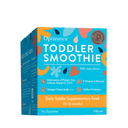
Optivance is not a multivitamin. It is a Formulated Supplementary Food for Young Children that provides food components and selected added nutrients.
Per serve, the confirmed formula provides:
- 10.6 g protein
- 1.9 g fibre
- 40 mg DHA
- Three billion CFU probiotics
- 16 vitamins and minerals plus lutein
It contains milk and soy and is prepared with water according to the standard directions.
It may suit families wanting a measured supplementary food option. It will not suit every child and should not replace professional assessment.
A simple decision table
| Situation | First step |
|---|---|
| Generally varied diet with occasional refusal | Continue normal meals and exposure |
| One nutrient concern | Seek targeted advice |
| Missing food group | Review suitable replacements |
| Several fortified products used | Compare all labels |
| Wants measured additional food option | Consider an age-specific smoothie |
| Poor growth, severe restriction or swallowing concerns | Seek professional assessment |
For families seeking more than a standard multivitamin, Optivance Toddler Smoothie provides protein, fibre, DHA, probiotics, and 16 vitamins and minerals plus lutein in an age-specific supplementary food for children aged 1–3. It is designed to complement a normal diet—not replace meals, varied foods or professional advice where feeding or growth is concerning. View the full nutrition, ingredients and preparation information → Optivance Toddler Smoothie product page.
Final thoughts
A multivitamin supplies selected micronutrients.
A fortified food combines ordinary food with added nutrients.
A toddler nutrition smoothie may provide both food components and selected micronutrients.
The right choice depends on the real problem—not which product has the longest list on the front.
Frequently asked questions
Is a toddler smoothie better than a multivitamin?
They perform different roles. A smoothie may provide protein, fibre and energy; a multivitamin usually focuses on micronutrients.
Can a multivitamin replace a missing food group?
Not fully. Food groups provide combinations of nutrients and food components.
Can my toddler use both?
Possibly, but review overlapping nutrients first.
Are fortified foods necessary?
Not always. They can be useful where they serve a clear role within the diet.
Is Optivance a medical nutrition product?
No. It is a consumer Formulated Supplementary Food for Young Children.
Disclaimer
This article provides general educational information and does not replace personalised dietary, medical or pharmaceutical advice.
References
- Healthdirect Australia. Dietary supplements.
- Food Standards Australia New Zealand. Supporting document: young child formula labelling.
- Food Standards Australia New Zealand. Food for special medical purposes.
- Optivance Toddler Smoothie product data sheet.


