





Toddler nutrition products often make similar front-of-pack promises.
One might focus on vitamins. Another might highlight protein, omega-3 or probiotics. Some are fortified milk drinks, some are supplementary foods, and others may be intended for children with specific medical or growth needs.
These products do not necessarily perform the same role.
A toddler nutrition smoothie can provide an additional source of selected nutrients, but it should not automatically be treated as a meal replacement, a treatment for fussy eating or something every toddler needs.
This guide was prepared by Optivance Nutrition, which makes an age-specific Toddler Smoothie. Optivance is discussed transparently after the broader buying criteria.
Choosing a toddler nutrition smoothie starts with understanding the broader eating pattern—not simply finding the product with the longest nutrient list. For a complete look at food-first strategies, fussy eating, supplementary nutrition and when professional support may be helpful, read our Practical guide to nutrition for fussy toddlers → Nutrition for Fussy Toddlers: A Practical Guide to Food, Supplements and Support.
The ten-part toddler smoothie check
Before choosing a product, check:
- Its intended age
- Its prescribed name and purpose
- How it is prepared
- Energy and serving size
- Protein
- Fibre and sugar
- Omega-3 and probiotics
- Vitamins and minerals
- Ingredients and allergens
- Cost, convenience and fit within the diet
1. Check the intended age
Begin with the age range.
A product intended for adults, teenagers or older children should not be assumed suitable for a toddler simply because it is sold as a smoothie or protein drink.
Look for:
- A clearly stated age range
- Serving directions for that age
- Whether the formulation is specifically made for children aged 1–3
- Whether advice is provided for children outside that range
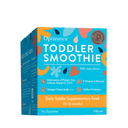
Optivance Toddler Smoothie is formulated for young children aged 1–3. Its product data sheet describes it as a Formulated Supplementary Food for Young Children.
2. Understand what the product is designed to do
Read the prescribed name or product description—not only the marketing headline.
A product might be:
- An ordinary smoothie or flavoured drink
- A fortified food
- A vitamin or mineral supplement
- A formulated supplementary food
- A medical nutrition product
- A protein product intended for another age group
Formulated supplementary foods for young children are regulated under Standard 2.9.3 of the Australia New Zealand Food Standards Code. The current category relates to foods made for ages 1–3 that supplement a normal diet where energy or nutrient intake may not meet an individual child’s requirements.
That does not mean every child needs one. It explains the product’s intended regulatory role.
Medical foods are different. They are used to manage the diets of people with particular diseases, disorders or medical conditions and may require clinical supervision.
3. Read the standard preparation directions
A powder’s nutritional profile depends on how it is prepared.
Check:
- Grams of powder per serve
- Amount of liquid
- Whether the standard liquid is water or milk
- Whether the product is shaken or blended
- Whether additions are optional recipe variations
- Whether it must be consumed immediately
- Maximum recommended daily servings
When comparing products, compare their standard prepared serves.
Adding milk, yoghurt, fruit, oats or nut paste can make a useful recipe, but it also changes the energy, protein, sugar, fibre and allergen profile. Do not compare an enhanced recipe with another product’s water-prepared serve.
The standard Optivance direction is one 25 g sachet with 180 mL water, shaken or blended until dissolved and consumed immediately.
4. Check serving size and energy
Serving sizes are chosen by manufacturers and can differ substantially.
A product might appear higher in protein or lower in sugar simply because its recommended serve is larger or smaller.
Check:
- Powder per serve
- Prepared volume
- Energy per prepared serve
- How realistic the serve is for your toddler
- Whether the product is being positioned as a snack, drink, supplement or meal
Australian nutrition information panels show nutrient quantities per serve and per 100 g or 100 mL. The listed serving size should be reviewed alongside the preparation directions.
A higher-energy product is not automatically better, and a lower-energy product is not automatically more appropriate. The role of the product and the child’s broader diet matter.
5. Look beyond a large protein number
Protein can come from:
- Milk powder
- Whey protein
- Soy
- Pea or other legumes
- Mixed protein sources
Ask:
- How much protein is provided per prepared serve?
- What are the protein sources?
- Does the product contain relevant allergens?
- Is the amount appropriate alongside the child’s other foods and products?
- Is protein being used to imply that the product is a complete meal when it is not?
The Australian protein RDI for children aged 1–3 is 14 g per day. This is an overall population reference—not an amount every shake should contain.
Understand toddler protein needs and food sources → Protein for Toddlers: The Protein Opportunity Method
6. Review fibre and sugar separately
Fibre and sugar answer different questions.
Fibre
Check:
- Whether dietary fibre is listed
- The amount per prepared serve
- The fibre source
- Whether the product is being promoted as a constipation treatment
A smoothie can contribute fibre, but it should not replace varied fruit, vegetables, legumes and grain foods. The Australian fibre AI for ages 1–3 is 14 g per day.
Sugar
The “sugars” line on an Australian nutrition panel represents total sugars. These may come from milk, fruit or added ingredients. The standard panel does not usually provide a separate added-sugars figure, so the ingredient list also needs to be checked.
Do not judge a toddler product using an arbitrary rule such as “anything above 5 g is high” without considering serving size, food category and sugar source.
Ask:
- How many grams of total sugars are in the prepared serve?
- What ingredients contribute sweetness?
- Is a “no added sugar” claim made?
- Does the claim still allow naturally occurring milk or fruit sugars?
- Is the drink likely to displace normal meals because it is frequently offered?
Learn how to read total sugars and ingredients together → How to Read a Toddler Nutrition Label
7. Identify the exact omega-3 and probiotics
“Contains omega-3” does not tell you enough.
Check:
- Whether the product contains ALA, DHA or EPA
- The quantity per serve
- Whether it comes from fish or algae
- Whether the front-label number matches the prepared serve
Australia sets a 40 mg Adequate Intake for combined DHA, EPA and DPA for children aged 1–3. It does not set a separate DHA-only RDI.
For probiotics, check:
- The organisms named
- The quantity in colony-forming units
- Whether actual strain identifiers are provided
- Storage directions
- Whether the amount is guaranteed through shelf life
- Whether treatment-style digestive or immune claims are being made
Probiotic effects can depend on the organism, strain and dose. Their presence alone should not be interpreted as treatment for constipation, diarrhoea or another condition.
8. Review vitamins and minerals as part of the whole formulation
More nutrients do not automatically make a product better.
Look for:
- Which vitamins and minerals are included
- Amount per prepared serve
- Percentage RDI where legally presented
- Whether nutrients overlap with a multivitamin, fortified cereal or toddler milk
- Whether the product provides macronutrients as well as micronutrients
- Whether the nutrient list fits the product’s intended purpose
Pay particular attention when combining several fortified products.
Vitamins and minerals back to food groups → Vitamins and Minerals for Toddlers: Start With Food Groups
Decide whether a separate multivitamin is necessary → Does My Fussy Toddler Need a Multivitamin?
9. Read the ingredient and allergen declarations
Ingredients on Australian food labels are generally listed in descending order by ingoing weight. This helps you identify the main base ingredients and distinguish them from ingredients present in much smaller quantities.
Check:
- The first few ingredients
- Protein and fibre sources
- Sweeteners
- Flavours
- Vitamin and mineral forms
- Allergens
- Dietary suitability
- Ingredients your toddler has not previously tolerated
Australian allergen rules require common allergens to be declared using prescribed plain-English names.
10. Consider cost and routine fit
Calculate:
Pack price ÷ number of serves = cost per standard serve
Then consider:
- Is each serve individually portioned?
- Does it need refrigeration before opening?
- Is preparation realistic?
- Will your toddler accept the texture?
- Is it likely to be used as intended?
- Is the product replacing foods your toddler would otherwise eat?
- Are you paying for ingredients that duplicate other supplements?
The lowest cost per serve is not automatically the best value. A product that is unsuitable for the child’s age, allergens or routine is poor value regardless of price.
Quick comparison checklist
| Check | Question to ask |
|---|---|
| Age | Is it specifically suitable for ages 1–3? |
| Purpose | What type of food or supplement is it? |
| Preparation | What is the standard powder-to-liquid ratio? |
| Energy | What does the prepared serve provide? |
| Protein | How much, and from which sources? |
| Fibre | Is it included and clearly quantified? |
| Sugar | What is the total sugar and what ingredients contribute it? |
| Omega-3 | Is it ALA, DHA or EPA? |
| Probiotics | Which organisms, how much and under what storage conditions? |
| Micronutrients | Does it overlap with other fortified products? |
| Allergens | Are milk, soy or other allergens present? |
| Cost | What is the cost per standard serve? |
How Optivance Toddler Smoothie fits
Optivance Toddler Smoothie is formulated for children aged 1–3 as a supplement to a normal diet.
The confirmed formula provides per 25 g serve:
- 10.6 g protein
- 1.9 g dietary fibre
- 40 mg DHA
- Three billion CFU of probiotics
- 16 vitamins and minerals plus lutein
The data sheet identifies milk solids and whey protein as the main protein-containing ingredients and lists partially hydrolysed guar gum as the fibre ingredient. It contains milk and soy.
It is not:
- A complete diet
- A medical nutrition product
- A treatment for fussy eating
- Necessary for every toddler
- A replacement for meals, chewing or food exploration
Understand every part of the formula → Optivance Toddler Smoothie Ingredients Explained
View current product information → Optivance Toddler Smoothie product page
When a buying guide is not enough
Seek individual advice when your toddler:
- Is losing weight or not growing as expected
- Has a very narrow or shrinking food range
- Relies on drinks for most nutrition
- Regularly coughs or chokes
- Has difficulty chewing or swallowing
- Has multiple allergies
- Needs a medically prescribed nutrition product
- Shows significant distress around eating
Final thoughts
A responsible toddler smoothie comparison starts with purpose, not the biggest front-label number.
Check the age, standard serve, ingredients, allergens and role within the diet. Compare similar products in their prepared form and consider what your toddler is already receiving from food and other fortified products.
The most appropriate product is not necessarily the one with the longest ingredient list. It is the one whose role, formulation and limitations are clear—and that fits safely alongside normal food.
Frequently asked questions
Is a toddler nutrition smoothie a meal replacement?
Not automatically. Check the product’s prescribed name and directions. Optivance is a supplementary food, not a complete meal replacement.
Does every fussy toddler need one?
No. Many families can support a fussy phase through meals, snacks and food-first changes.
Should I choose the product with the most protein?
Not necessarily. Consider total daily intake and whether the product provides the other features you are seeking.
Is lower sugar always better?
Compare total sugars, serving size, ingredients and product purpose rather than using one number alone.
Are probiotics essential in a toddler smoothie?
No. They are an optional formulation feature, and their effects depend on the organism, strain and dose.
Can I compare products per 100 g?
Per 100 g helps compare powder concentration, but the prepared serving is usually more relevant to what the toddler consumes.
Can I combine a toddler smoothie with a multivitamin?
Review overlapping nutrients first and seek professional advice when uncertain.
What allergens does Optivance contain?
The current product information declares milk and soy.
Disclaimer
This article provides general educational information and is not a substitute for personalised medical, dietetic or feeding advice.
References
- Food Standards Australia New Zealand. Food Standards Code legislation. Updated 2026.
- Food Standards Australia New Zealand. Supporting document: labelling under Proposal P1066. 2026.
- Food Standards Australia New Zealand. Nutrition information panels. 2025.
- Healthdirect Australia. How to read food labels. Accessed 25 July 2026.
- Optivance Toddler Smoothie product data sheet. Last reviewed December 2023.


