
















Your toddler has eaten the same small group of foods for several weeks.
A children’s multivitamin can seem like simple insurance. But it may be unnecessary, fail to address the actual limitation in your toddler’s diet or overlap with nutrients already supplied through fortified foods.
The quick answer
Some toddlers may benefit from supplements, but fussy eating alone does not mean a child needs a multivitamin.
Before choosing one, review:
- The variety of foods your toddler eats
- Any food groups that are consistently excluded
- Medical, dietary or growth factors
- Fortified foods and supplements already being used
- Whether targeted support would make more sense
A multivitamin can supply selected vitamins and minerals. It cannot replace complete food groups, provide a varied diet or resolve a feeding difficulty.
For a broader look at food-first strategies, supplementary nutrition and when professional advice may help, read our Practical guide to nutrition for fussy toddlers → Nutrition for Fussy Toddlers: A Practical Guide to Food,Supplements and Support
Question 1: How broad is your toddler’s eating pattern?
A toddler may eat only a small number of individual foods but still receive foods from several groups.
For example:
- Toast
- Yoghurt
- Banana
- Egg
- Hummus
This is repetitive, but it includes grains, dairy, fruit and protein foods.
Compare that with a child eating almost entirely bread, crackers and milk. The second pattern may deserve closer nutritional review because fewer food groups are represented.
Before focusing on vitamins, write down the exact foods your toddler currently accepts.
Include the form in which they eat each food:
- Smooth yoghurt without pieces
- Dry toast strips
- Banana blended into a smoothie
- Scrambled egg
- Hummus served as a dip
This provides a clearer picture than simply describing your toddler as “fussy”.
Use the five-part check to review your toddler’s broader diet → Is Your Toddler Getting Enough Nutrition?
Question 2: Is an entire food group consistently excluded?
A multivitamin might provide several micronutrients, but it does not fully replace a missing food group.
When dairy and suitable alternatives are excluded
This may affect access to nutrients such as:
- Calcium
- Protein
- Iodine
- Vitamin B12
- Riboflavin
A multivitamin may contain some calcium, but many provide only a small amount. It will not necessarily replace the protein, energy and other nutrients supplied by dairy foods or a suitable alternative.
When meat, fish, egg, tofu and legumes are excluded
This may affect food sources of:
- Protein
- Iron
- Zinc
- Vitamin B12
- Long-chain omega-3
A basic vitamin gummy may not provide meaningful protein, iron or DHA.
When fruit and vegetables are almost completely absent
This may reduce sources of:
- Vitamin C
- Folate
- Vitamin A precursors
- Fibre
- Potassium
A multivitamin may supply selected vitamins, but it does not provide the same fibre, food structure or sensory experience as eating plant foods.
When grain foods are extremely limited
Grain foods can contribute:
- Energy
- B-group vitamins
- Fibre
- Iron, particularly where fortified
The important question is not simply whether your toddler refuses one food. It is whether there is another suitable food providing a similar role.
Understand how food groups provide toddler vitamins and minerals → Vitamins and Minerals for Toddlers: Start With Food Groups
Question 3: Is there a specific medical or dietary reason?
Supplements may be considered when a toddler has:
- A diagnosed deficiency
- A vegan diet requiring reliable vitamin B12
- Several food allergies
- A medical condition affecting nutrient absorption
- An identified vitamin D risk
- Poor growth
- A highly restricted diet
- Professional advice recommending supplementation
In these situations, a general multivitamin may or may not be the most appropriate choice.
A health professional might instead recommend:
- Iron after assessment or blood testing
- Vitamin D for an identified risk
- Vitamin B12 for a vegan diet
- Calcium planning when dairy is excluded
- A complete dietary review
- Feeding support for severe restriction
A targeted approach addresses the actual concern rather than assuming every nutrient is low.
Question 4: What fortified products are already being used?
Before buying a multivitamin, list everything your toddler already receives.
This might include:
- Iron-fortified cereal
- Calcium-fortified plant drink
- Toddler milk
- A supplementary toddler smoothie
- Vitamin D drops
- Iron drops
- Omega-3 products
- Probiotic products
- Gummies, powders or chewable supplements
Then compare the labels together.
A toddler may receive the same nutrient from several sources without the parent realising it.
For example, vitamin B6, vitamin D, iodine or iron might appear in:
- A multivitamin
- A fortified cereal
- A toddler nutrition drink
- An individual supplement
The issue is not that fortified foods or supplements are automatically harmful. It is that each product should have a clear purpose.
Learn how to compare serving sizes, nutrients and ingredients → How to Read a Toddler Nutrition Label
Question 5: Would targeted support make more sense?
A broad multivitamin is not always the most useful response.
Consider the actual issue.
| Situation | More useful first step |
|---|---|
| Eats several food groups but dislikes variety | Continue gradual food exposure |
| One food group is consistently absent | Review suitable replacements |
| Vegan diet | Plan reliable B12 and broader nutrition support |
| Multiple food allergies | Seek dietetic guidance |
| Pale, tired or growing poorly | See a GP rather than self-treating |
| Severe restriction or distress | Seek feeding and medical assessment |
| Several fortified products already used | Compare labels with a pharmacist or dietitian |
| Diagnosed deficiency | Follow the prescribed treatment plan |
What can a toddler multivitamin provide?
Depending on the product, it may provide:
- Selected vitamins
- Selected minerals
- A measured daily amount
- Support for an identified dietary need
Different products contain different nutrients and amounts. The word “multivitamin” does not mean the product provides every vitamin and mineral a toddler needs.
What can a multivitamin not provide?
A multivitamin cannot provide:
- A complete diet
- Reliable food energy
- Meaningful protein in most products
- Fibre in most products
- Essential fats unless specifically included
- Chewing and texture practice
- Food variety
- Treatment for severe feeding difficulties
- Diagnosis of a nutritional deficiency
- Assessment of growth
It also cannot teach a toddler to become comfortable with unfamiliar foods.
How to review a toddler multivitamin label
Check the intended age
Choose a product specifically suitable for your toddler’s age.
Do not give an adult supplement or estimate a smaller toddler dose unless a qualified health professional has directed you to do so.
Check the serving directions
Do not assume one gummy, dropper or teaspoon is the intended serve.
Follow the stated amount carefully.
Compare nutrient quantities
Review how much of each nutrient is provided and whether the same nutrients appear in other fortified products.
Look carefully at iron
Some multivitamins contain iron and others do not.
Iron supplements should not be given “just in case”. Excessive iron can be dangerous, and suspected deficiency should be discussed with a GP.
Review the format
Gummies can look like lollies to a toddler.
Store all vitamins and supplements:
- In their original containers
- High and out of reach
- Preferably in a locked cupboard
Check allergens
Review declarations for:
- Milk
- Soy
- Gluten-containing cereals
- Peanuts
- Tree nuts
- Sesame
- Other allergens relevant to your child
Be cautious with broad promises
A multivitamin should not be expected to:
- Cure fussy eating
- Prevent all illness
- Improve behaviour
- Replace vegetables
- Guarantee complete nutrition
Is a toddler nutrition smoothie the same as a multivitamin?
No.
A multivitamin is mainly designed to provide selected vitamins and minerals.
A toddler nutrition smoothie may also provide food components such as:
- Protein
- Fibre
- Energy
- Fats or DHA
- Probiotics
The two product types therefore serve different purposes.
Compare toddler smoothies, multivitamins and fortified foods → Toddler Smoothies, Multivitamins and Fortified Foods: What Is the Difference?
Where Optivance Toddler Smoothie may fit
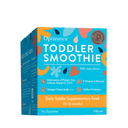
Optivance Toddler Smoothie is a Formulated Supplementary Food for Young Children made for ages 1–3.
It provides:
- Protein
- Dietary fibre
- DHA omega-3
- Probiotics
- 16 vitamins and minerals plus lutein
It is not the same as a standard multivitamin because it also provides food-based nutritional components.
It is designed to supplement a normal diet—not replace:
- Meals
- Food variety
- Chewing and texture experiences
- Medical assessment
- A prescribed supplement
- Feeding support where restriction is severe
Parents combining Optivance with a multivitamin, fortified toddler drink or individual supplement should compare the labels for overlapping nutrients.
View the complete nutrition panel, ingredients and preparation directions → Optivance Toddler Smoothie product page
A simple decision checklist
Before buying a multivitamin, ask:
- Does my toddler regularly eat foods from several food groups?
- Is one entire group consistently absent?
- Is there a suitable food replacement?
- Is a fortified food already contributing the nutrients I am concerned about?
- Is another supplement already being used?
- Does my toddler have poor growth, low energy or another health concern?
- Would targeted advice be more useful than a general multivitamin?
A small dinner alone is not enough information to answer these questions.
When to seek professional advice
Speak with a GP, child and family health nurse, accredited practising dietitian or pharmacist if your toddler:
- Is losing weight or not growing as expected
- Appears unusually pale or tired
- Excludes several food groups
- Follows a vegan diet without a reliable B12 plan
- Has several allergies
- Relies on drinks for most nutrition
- Has a very narrow or shrinking food range
- Uses several fortified products
- Has difficulty chewing or swallowing
- Becomes highly distressed around food
These concerns need more than a general supplement decision.
Final thoughts
A multivitamin can be useful in the right circumstances, but it is not automatic insurance against every consequence of fussy eating.
Start by reviewing the broader eating pattern.
Identify which food groups your toddler receives, what is genuinely missing and which fortified foods or supplements are already being used.
Then choose food-first changes, a suitable replacement, targeted supplementation or professional support according to the real need.
Frequently asked questions
Should every fussy toddler take a multivitamin?
No. Fussy eating alone does not establish that a toddler has a deficiency or needs a supplement.
Can a multivitamin replace vegetables?
No. It does not provide the full fibre, food structure, texture and variety supplied by eating vegetables and other plant foods.
Can I give a multivitamin and Optivance together?
The products may contain overlapping nutrients. Compare both labels and seek professional advice when uncertain.
Should I give iron just in case?
No. Iron supplements should be used under professional guidance.
Are gummy vitamins safe?
Use only age-appropriate products according to the directions and store them securely because toddlers may view them as lollies.
Can a multivitamin improve fussy eating?
A multivitamin can provide selected nutrients, but it does not resolve the reasons a toddler refuses food.
Who can help me choose a supplement?
A GP, accredited practising dietitian or pharmacist can review your toddler’s diet, health needs and current products.
Disclaimer
This article provides general educational information and is not a substitute for personalised medical, nutritional or pharmaceutical advice. Always follow product directions and seek professional support for suspected deficiencies, poor growth, allergies or severe food restriction.
Australian Government, Eat for Health. Australian Dietary Guidelines 1–5. Accessed 26 July 2026. Supports the food-first approach and the five food groups.
Australian Government, Eat for Health. Recommended Number of Serves for Children, Adolescents and Toddlers. Accessed 26 July 2026. Supports the broader dietary pattern for children aged 1–3.
Australian Government, Eat for Health. Nutrient Reference Values for Australia and New Zealand. Accessed 26 July 2026. Supports the explanation of population nutrient recommendations and safe intake ranges.
Australian Government, Eat for Health. Iron: Nutrient Reference Values. Accessed 26 July 2026. Supports the toddler iron RDI and the need to consider iron separately from a general multivitamin.
Australian Government, Eat for Health. Calcium: Nutrient Reference Values. Accessed 26 July 2026. Supports the discussion of calcium when dairy foods are excluded.
Australian Government, Eat for Health. Vitamin B12: Nutrient Reference Values. Accessed 26 July 2026. Supports the discussion of vitamin B12 and restricted diets.
Australian Government, Eat for Health. Vitamin D: Nutrient Reference Values. Accessed 26 July 2026. Supports the discussion of vitamin D needs and individual risk.
Healthdirect Australia. Vitamins and Minerals Explained. Accessed 26 July 2026. Supports the explanation that vitamins and minerals are needed in small amounts and are generally obtained through a varied diet.
Healthdirect Australia. Dietary Supplements. Accessed 26 July 2026. Supports the advice that supplements may help where nutrients are missing but should not automatically replace balanced eating or professional guidance.
Healthdirect Australia. Vegetarian and Vegan Diets. Accessed 26 July 2026. Supports the sections on vegan diets, reliable vitamin B12 and the need to plan nutrients such as iron, calcium, iodine, zinc and omega-3.
Therapeutic Goods Administration. How Are Vitamins Regulated in Australia? Accessed 26 July 2026. Supports following age-appropriate label directions and treating vitamin products as regulated medicines rather than ordinary lollies or foods.
Therapeutic Goods Administration. What’s on My Medicine Label? Accessed 26 July 2026. Supports checking active ingredients, serving directions and the product’s Australian Register of Therapeutic Goods number.
Queensland Health. Paediatrics: Iron Supplement Guidance. Accessed 26 July 2026. Supports the warning that iron overdose can be fatal and that iron products must be kept out of children’s reach.
Healthdirect Australia. Swallowed Substances. Accessed 26 July 2026. Supports secure supplement storage and contacting the Poisons Information Centre on 13 11 26 if a child may have swallowed too much.
Optivance Nutrition. Optivance Toddler Smoothie Current Product Label and Product Data Sheet.


