
















An ingredient list can make a straightforward food sound surprisingly technical.
“Ferric pyrophosphate”, “partially hydrolysed guar gum” and “Lacticaseibacillus rhamnosus” may be unfamiliar names, but each has a defined role in the formula.
A long ingredient list is not automatically evidence that a product is better—or worse. In a formulated supplementary food, the list includes the base foods as well as the forms of fibre, vitamins, minerals, DHA and probiotics used to create the declared nutritional profile.
The complete ingredient list
The confirmed formula contains:
Milk Solids [Whole Milk Powder (Milk, Emulsifier (Soy Lecithin), Whey Protein Concentrate (Milk)], Fibre (Partially Hydrolysed Guar Gum), Minerals (Tri Calcium Phosphate, Magnesium Citrate, Ferric Pyrophosphate, Zinc Sulphate, Potassium Iodide), Natural Flavour, Algal DHA Powder, Acerola Juice Powder, Vitamins (Mixed Carotenes, Vitamin E, Niacin, Vitamin D, Vitamin B12, Thiamin, Riboflavin, Pyridoxine, Calcium L-Methyltetrahydrofolate), Natural Sweetener (Monk Fruit Extract), Probiotic Bacteria (Lactobacillus acidophilus, Bifidobacterium animalis, Lacticaseibacillus rhamnosus), Red Seaweed (Lithothamnion calcareum), Faba Bean Protein, Kelp Powder, Organic Barley Grass Powder and Lutein.
Contains milk and soy, these are the declared allergens
The formula at a glance
| Ingredient group | Main role in the formula |
|---|---|
| Milk solids and whey | Main base and protein source |
| Partially hydrolysed guar gum | Fibre source |
| Mineral salts | Supply declared mineral nutrients |
| Algal DHA | Preformed DHA omega-3 |
| Acerola and vitamin ingredients | Contribute to declared vitamin profile |
| Monk fruit extract | Sweetness |
| Probiotic bacteria | Declared live microorganisms |
| Red seaweed and kelp | Mineral-containing supporting ingredients |
| Lutein | Additional carotenoid |
| Natural flavour | Flavour consistency |
Understanding the ingredients is only one part of deciding whether a toddler nutrition smoothie is right for your family. It also helps to consider your toddler’s overall eating pattern, accepted foods, appetite and whether food-first changes or professional support may be more appropriate. For the broader picture, read our Practical guide to food, supplements and support for fussy toddlers → Nutrition for Fussy Toddlers: A Practical Guide to Food, Supplements and Support.
Milk solids: the main base
The first ingredient group is milk solids, including:
- Whole milk powder
- Whey protein concentrate
These ingredients are the main contributors to the product’s protein.
The current data sheet lists 10.6 g protein per 25 g serve.
Because the formula contains milk ingredients, it is not suitable for children with a milk allergy unless an appropriate health professional has advised otherwise.
Why soy is declared
Soy lecithin appears as an emulsifier within the whole milk powder ingredient.
An emulsifier helps ingredients disperse and combine more consistently.
Because soy is a regulated allergen, the finished product declares soy even though soy protein is not the main protein source. Australian allergen rules require prescribed allergens to be declared clearly.
Partially hydrolysed guar gum
Partially hydrolysed guar gum, often shortened to PHGG, is the declared fibre ingredient.
The product data sheet lists:
- 2.1 g PHGG per serve
- 1.9 g dietary fibre per serve
It contributes to the product’s measured fibre content.
Fibre is not a treatment for constipation or a replacement for varied plant foods. The Australian fibre AI for ages 1–3 is 14 g per day.
Learn how to build fibre from ordinary food → Fibre for Toddlers: Simple Food-First Steps
The mineral ingredients
The formula declares these mineral forms:
- Tri calcium phosphate
- Magnesium citrate
- Ferric pyrophosphate
- Zinc sulphate
- Potassium iodide
The nutritional panel also lists phosphorus.
Together, the product provides declared amounts of:
- Calcium
- Magnesium
- Phosphorus
- Iron
- Zinc
- Iodine
Chemical-sounding mineral names describe the forms used in the formulation. They should be assessed according to the declared nutrient amounts and product suitability—not simply whether their names sound familiar.
Per serve, the data sheet lists:
- 350 mg calcium
- 20 mg magnesium
- 150 mg phosphorus
- 3 mg iron
- 1.1 mg zinc
- 35 micrograms iodine
Algal DHA powder
The product uses algal DHA rather than fish oil.
The data sheet lists 40 mg DHA per serve.
DHA is a long-chain omega-3 fatty acid. Australian guidance sets a 40 mg AI for combined DHA, EPA and DPA—not a separate DHA-only RDI.
The product is providing 40 mg DHA, not “100% of the DHA RDI”.
Understand ALA, DHA and EPA → Omega-3 for Toddlers: What Mums Need to Know
Acerola juice powder and vitamins
The formula contains acerola juice powder and added vitamin ingredients.
The declared vitamin profile includes:
- Vitamin A from mixed carotenes
- Thiamin, or vitamin B1
- Riboflavin, or vitamin B2
- Niacin, or vitamin B3
- Vitamin B6
- Folate
- Vitamin B12
- Vitamin C
- Vitamin D
- Vitamin E
Combined with the six declared minerals, this is 16 vitamins and minerals, with lutein listed separately.
Calcium L-methyltetrahydrofolate
This is the form of folate included in the formula.
Its technical name may appear unfamiliar, but it is listed within the vitamin blend to provide the declared folate amount.
The data sheet lists 45 micrograms folate per serve.
Monk fruit extract
Monk fruit extract is the declared sweetener.
The nutritional panel still lists 5.3 g total sugars per serve, largely reflecting the complete formulation rather than the sweetener alone.
Total sugars and added sugars are not the same measurement. The public article should not make a regulatory “no added sugar” claim unless the current final label and legal review support it.
Probiotic bacteria
The formula identifies three probiotic species:
- Lactobacillus acidophilus
- Bifidobacterium animalis
- Lacticaseibacillus rhamnosus
The data sheet lists a combined three billion CFU per serve.
The document names the species but does not provide individual strain codes.
That distinction matters because probiotic effects can depend on the specific strain and dose. Different probiotics should not be treated as interchangeable, and their presence should not be promoted as treatment for digestive problems or illness.
Red seaweed
The ingredient list includes red seaweed, identified as Lithothamnion calcareum.
This is a mineral-containing ingredient included in a small amount within the wider formula.
It should not be singled out as a standalone therapeutic ingredient.
Faba bean protein
Faba bean protein is included in the ingredient list.
The product data sheet lists 25 mg per serve, so it should not be presented as one of the formula’s main protein sources. Milk solids and whey protein make the principal contribution.
Kelp powder
Kelp powder is included at 12.5 mg per serve according to the data sheet.
Kelp naturally contains iodine, but iodine levels in seaweed ingredients can vary. The useful consumer figure is the finished product’s declared iodine amount rather than assumptions based on kelp alone.
Organic barley grass powder
Organic barley grass powder is included at 5 mg per serve.
At this quantity, it should not be promoted as a major source of vegetables, fibre or micronutrients.
A very small “green” ingredient does not replace ordinary exposure to vegetables and other plant foods.
Lutein
Lutein is listed separately from the 16 vitamins and minerals.
The product data sheet lists 100 micrograms per serve.
The presence of lutein should be stated factually rather than used to make exaggerated developmental or vision claims.
Natural flavour
Natural flavour is included to create a consistent mild flavour.
The term does not mean the product is allergen-free or made entirely from unprocessed ingredients. The full ingredients and allergen declarations remain more informative than the word “natural”.
What the formula provides per serve
| Component | Amount |
|---|---|
| Energy | 433 kJ / 103 Cal |
| Protein | 10.6 g |
| Total fat | 3.7 g |
| Total sugars | 5.3 g |
| Dietary fibre | 1.9 g |
| DHA | 40 mg |
| Probiotics | 3 billion CFU |
| Calcium | 350 mg |
| Iron | 3 mg |
| Lutein | 100 micrograms |
What the ingredient list does not mean
The formula should not be interpreted as:
- A replacement for a varied diet
- A serving of vegetables
- A medical nutrition product
- A constipation treatment
- A treatment for digestive problems
- A guarantee that a child will accept new foods
- Complete nutrition for the entire day
Preparation and allergens
The standard preparation is:
Add one 25 g sachet to 180 mL water. Shake or blend until completely dissolved and consume immediately.
The box contains 14 sachets.
The product contains milk and soy.
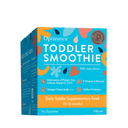
Understanding the ingredients can help you see what each part of the formula contributes, but the complete product information should always be reviewed together. The Optivance Toddler Smoothie product page includes the full ingredient list, Nutrition Information Panel, preparation directions, allergen information and available purchase options. View the complete Optivance Toddler Smoothie product information → Optivance Toddler Smoothie product page.
Final thoughts
The most useful way to assess an ingredient list is to group ingredients by their purpose.
In Optivance Toddler Smoothie:
- Milk solids provide the base and most of the protein.
- PHGG provides fibre.
- Algal powder provides DHA.
- Vitamin and mineral ingredients create the declared micronutrient profile.
- Probiotic species provide the declared CFU count.
- Flavour and monk fruit shape the taste.
- Supporting plant and marine ingredients are present in smaller amounts.
The formula provides a consistent supplementary serve. It does not replace normal meals, food variety or professional support where feeding or growth is concerning.
Frequently asked questions
Is Optivance dairy-free?
No. It contains whole milk powder and whey protein concentrate.
Why does it contain soy?
Soy lecithin is used as an emulsifier and requires soy allergen declaration.
Is it vegan?
No. It contains milk ingredients.
What is the main protein source?
Milk solids and whey protein concentrate.
What is the fibre source?
Partially hydrolysed guar gum.
Is the DHA from fish?
No. The formula uses algal DHA powder.
Are probiotic strains identified?
The data sheet identifies three species but does not provide individual strain codes.
Does it contain 16 or 17 vitamins and minerals?
The confirmed wording for current content is 16 vitamins and minerals plus lutein. Final website and packaging wording should be aligned before publication.
Does it contain sugar?
The nutrition panel lists 5.3 g total sugars per serve.
Is it suitable for milk or soy allergy?
No. It declares both milk and soy.
Disclaimer
This article explains the current confirmed formula for general educational purposes. Always check the current pack because formulations and labelling can change.
References
- Optivance Toddler Smoothie product data sheet, reviewed 22 December 2023.
- Food Standards Australia New Zealand. Allergen labelling for consumers.
- Healthdirect Australia. Probiotics.
- Australian Government, Eat for Health. Fats and fatty acids: Nutrient Reference Values.


